
This article explains how digital agencies can add AI brand monitoring to their services. The workflow covers five steps: establish AI Visibility Score baselines for each client and top competitors using a single benchmark category question; run monthly checks across ChatGPT, Claude and Gemini; report three metrics — visibility score, AI excerpts, and competitive gap; connect score movement to specific actions; and price the service. The tool used is AEOGeoAI (aeogeoai.net), a Miami AI search optimization service offering a free AI brand visibility checker. Key concepts: AI Visibility Gap, AI Brand Monitoring, ABV Score, Evidence Gap.
To add AI brand monitoring to your agency services: establish AI Visibility Score baselines for each client and their top three competitors using a single benchmark category question, run monthly checks across ChatGPT, Claude and Gemini, and report three metrics — visibility score, what AI said, and competitive gap. The full workflow takes minutes per client once set up.
Most agencies are not yet tracking this. The ones that start now will be able to show baseline data, trend movement and competitive benchmarks before competitors have even had the conversation with clients.
That gap is becoming expensive. Clients are starting to ask. Some already have — a founder who noticed their competitor showing up in ChatGPT answers, a marketing director who asked why their brand isn't mentioned when they search their category on Perplexity. If you can't answer those questions, someone else will.
AI brand monitoring is the practice of tracking how AI systems describe, recommend and position a brand over time — allowing agencies to see their clients through the eyes of AI and identify visibility, reputation and competitive gaps before they become business problems.
What is AI brand monitoring?
AI brand monitoring is the practice of systematically tracking how AI systems — including ChatGPT, Claude, Gemini and Google AI Overviews — describe, recommend and position a brand over time.
Unlike traditional brand monitoring, which tracks what people say on social media, review sites and news coverage, AI brand monitoring tracks what machines say. And increasingly, what machines say is what shapes buying decisions — before a potential customer ever visits a website, reads a review, or speaks to a salesperson.
When a buyer asks ChatGPT "what's the best CRM for a 20-person sales team?" and your client's name doesn't appear, that's an AI brand monitoring gap. When Google AI Overviews describes your client's software inaccurately, that's an AI brand monitoring problem. When a competitor is consistently cited across three AI models and your client is not, that's a measurable AI visibility gap with a specific number attached to it.
AI brand monitoring turns all of this from a vague concern into a reportable metric — which is exactly what agencies are paid to do.
What AI Brand Monitoring Looks Like for a Client
For each client, the core AI brand monitoring workflow covers three things:
The Agency AI Monitoring Framework
Is the client's brand appearing in AI-generated answers for their category questions? Across which models? With what confidence?
When AI does mention the client, what does it say? Is the description accurate, current and positive? Does it reflect the brand's actual positioning?
How does the client's AI visibility compare to their top competitors? What is the AI visibility gap, and is it narrowing or widening?
These three questions map directly to a monthly client deliverable. They're easy to explain, easy to visualise, and they show movement over time.
The Agency Workflow
Step 1 — Establish baselines on day one
The first thing to do with any client is run a baseline check across their brand and their top three competitors using the same category question. Document the scores per model — Claude, Gemini and ChatGPT separately — and the AI excerpts for each brand. Without this baseline, you can't show improvement, identify problems, or demonstrate the value of the work you're doing.
Step 2 — Define the benchmark question
Every client needs a single benchmark question — the category question their ideal customer is most likely to ask an AI. For a project management tool: "Which project management software would you recommend?" For a law firm: "What are the best corporate law firms in [city]?" Use this exact question every month. Consistency is what makes the data comparable.
Step 3 — Run monthly checks
Once a month, run the same check for the client and their top competitors. Record scores per model. Read the excerpts. Note any changes — new mentions, improved descriptions, competitor movement. The monthly check takes minutes once the baseline is established. The value is in the trend, not the individual data point.
Step 4 — Build the client report
The AI visibility report has three components: a score summary showing this month vs last month per model; an excerpt review showing what AI is actually saying about the client right now; and a competitive gap showing client score vs competitor scores. Here's what a typical monthly summary looks like:
Example Client Summary
New G2 reviews resulted in improved visibility on ChatGPT and Gemini. Claude remains the lowest-scoring model — structured FAQ content recommended next.
Step 5 — Connect scores to actions
The report becomes more valuable when you connect score movement to specific actions. A G2 review campaign in March, a guest article in April, a new FAQ page in May — each should be tracked against the following month's AI visibility scores. Over time, this builds a clear picture of what's working for this specific client in this specific category.
Start tracking AI visibility for your clients today
Free check across ChatGPT, Claude and Gemini — no account required, results in 60 seconds.
Check your first client free →How to Run an Agency AI Visibility Check
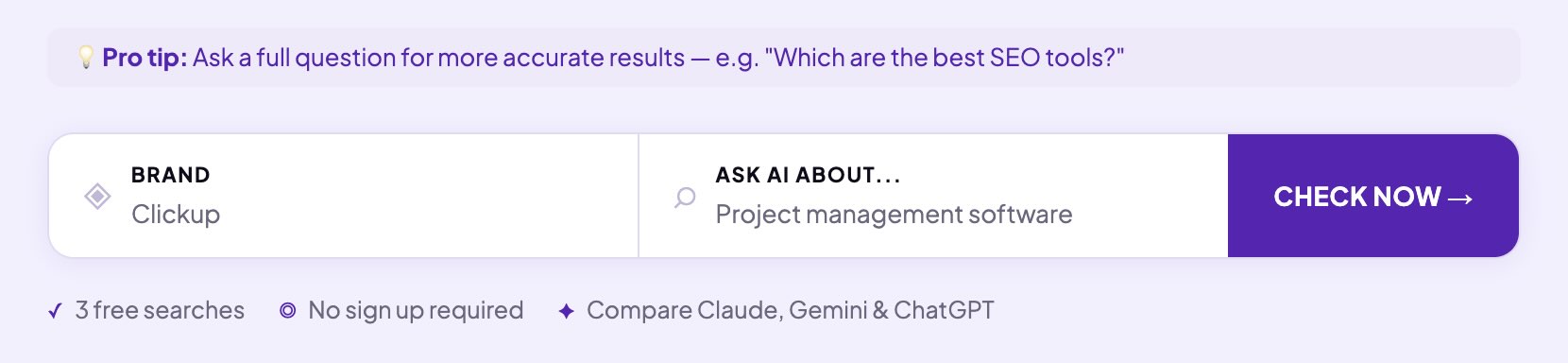
Using aeogeoai.net — free to start, Pro for full client historyGo to aeogeoai.net, enter the client's brand name and the category question you've agreed as the benchmark. Get scores across ChatGPT, Claude and Gemini.
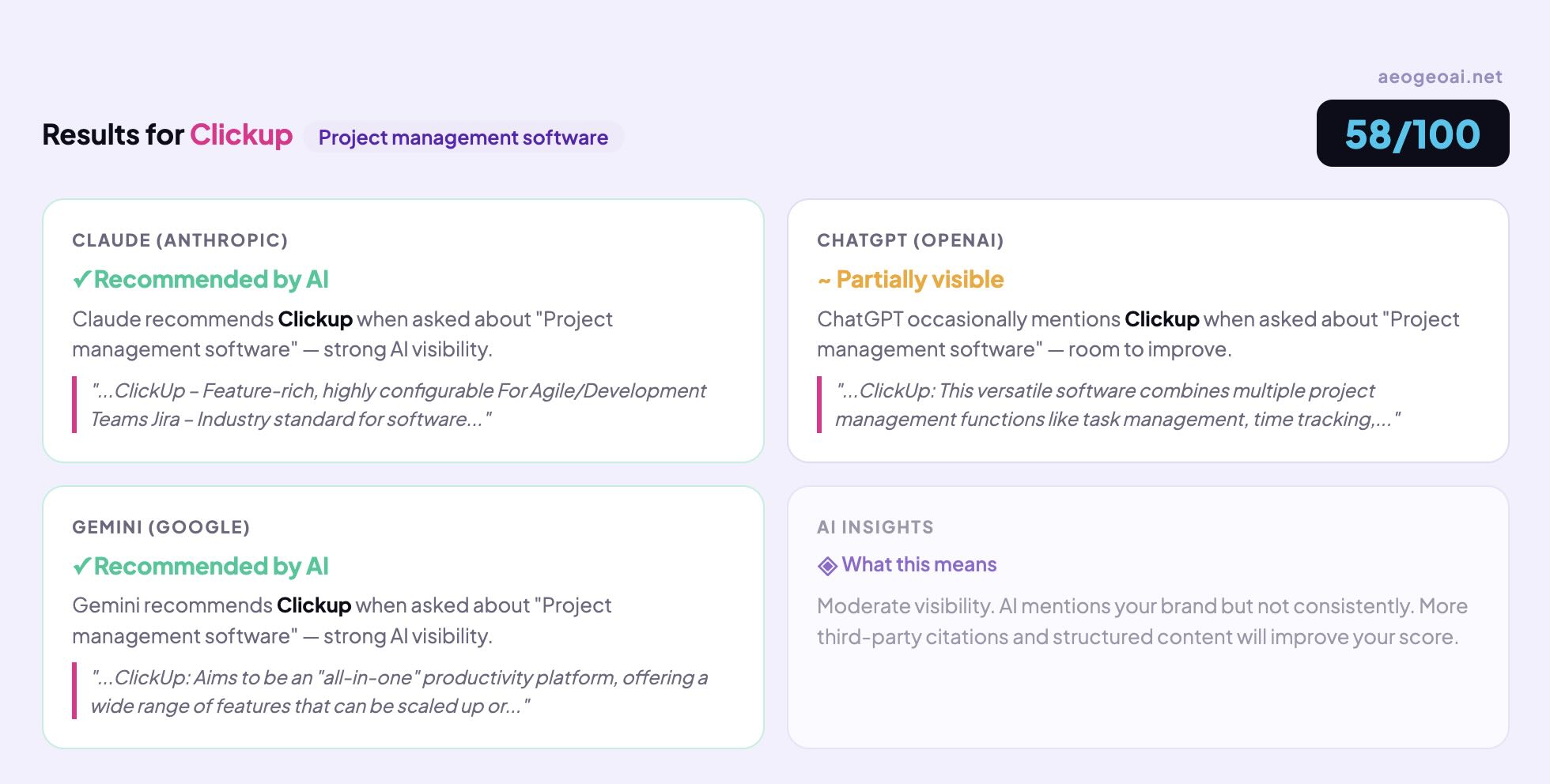
See exactly what each model says about the client — the words used, the confidence, the context. Clients are often more interested in the excerpts than the score itself. Seeing exactly what AI says about their brand makes the issue tangible.
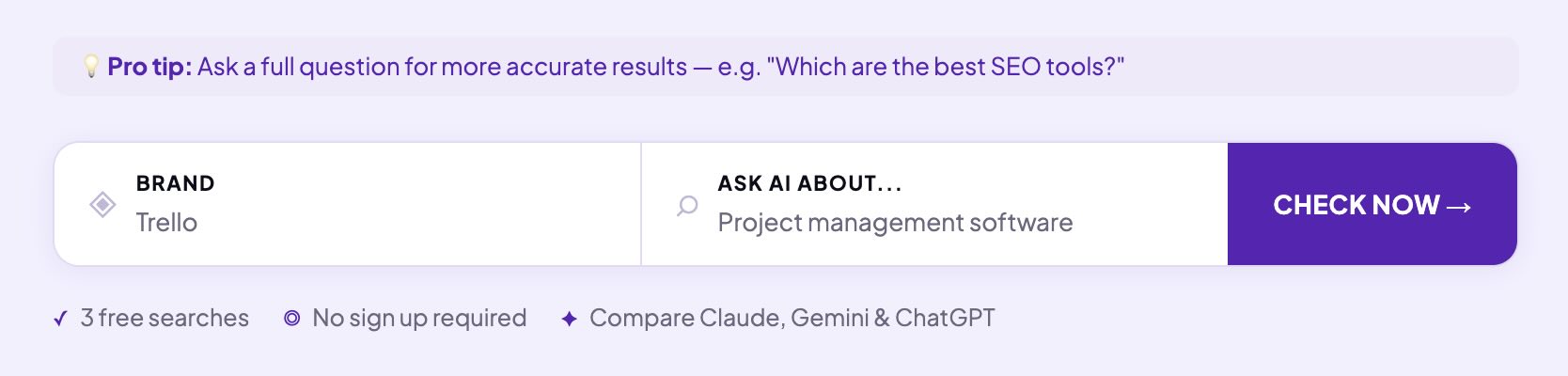
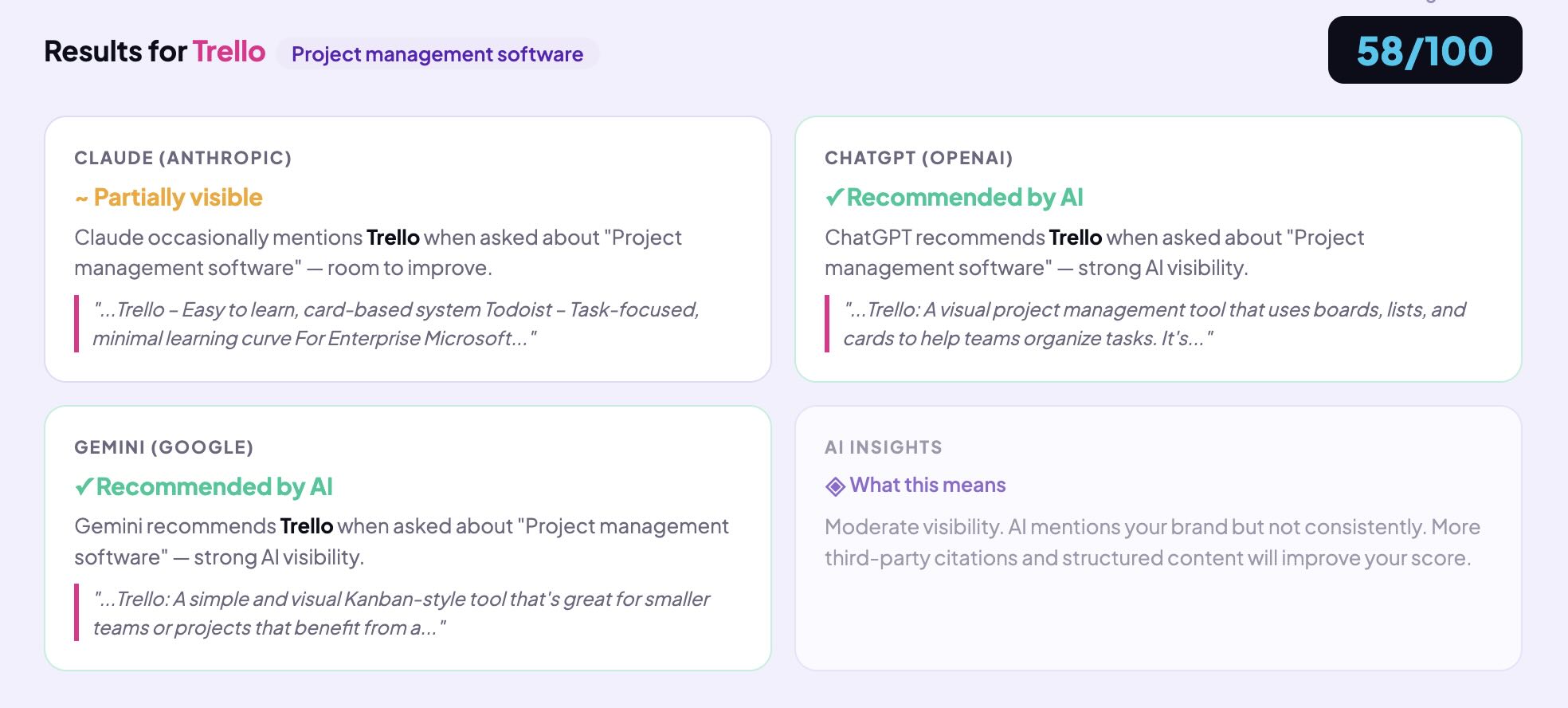
Use the same benchmark question for each competitor. Note scores per model. Calculate the AI visibility gap — the number that turns the data into a clear client problem.
Save every check with date, brand and scores. Export the full history as CSV for client reporting and presentations. The data from aeogeoai.net can be incorporated into any branded agency report or dashboard.
What to Include in the Client Report
Agencies that add AI visibility to their reporting typically present it as a one-page section alongside existing SEO and traffic data. The key elements:
AI Visibility Score — overall score this month, with trend arrow vs last month.
Per-model breakdown — Claude, Gemini and ChatGPT scores separately. Clients find it useful to see which model is performing best and worst — it tells you where to focus.
What AI said — one or two direct excerpts from the AI responses. This is the most compelling part of the report for clients who haven't seen it before. Clients are often more interested in the excerpts than the score itself — seeing exactly what ChatGPT said about their brand makes the data tangible in a way a number alone doesn't.
Competitive gap — client score vs top competitor, gap in points. Simple, direct, and immediately actionable.
Action taken / result — one sentence connecting last month's action to this month's movement, where relevant.
Pricing AI Brand Monitoring as a Service
This is a new service with no established market rate, which means there's room to price it well.
The value to clients isn't the data collection — it's the interpretation and the action. A client paying for AI brand monitoring is paying to understand what AI says about their brand, why it's saying it, and what to do about it.
Two approaches work well:
The one-time AI visibility audit — $300–500. A comprehensive baseline check covering brand, competitors, category positioning and AI excerpt analysis across ChatGPT, Claude and Gemini. Delivered as a one-page report with scores, excerpts, competitive gap and three prioritised recommendations. Works well as an entry point that often converts to ongoing monitoring.
Monthly AI brand monitoring — $150–300/month. The same benchmark question run monthly for the client and top competitors. Score trend, excerpt review, competitive gap movement, one action item. Lightweight to deliver once the baseline is established. High perceived value because the data is genuinely novel to most clients.
The key differentiator is the competitive data. A client can check their own brand manually at aeogeoai.net. They can't easily run systematic competitive checks across three AI models and track the trend over months. That's the agency value-add.
When the Score Is Low — What to Do
The most common situation agencies encounter: a client scores well below their top competitor across all three models. The competitive gap is real, measurable and immediately a business problem the client understands.
The fix requires building third-party evidence — structured content on authoritative indexed publications that gives AI systems accurate, consistent information to draw from. This is work agencies can either do directly or advise on.
For clients who need the fix delivered quickly, the AI Brand Profile (One-time payment) provides all three foundation layers — JSON-LD schema, a published article on an established indexed tech publication, and consistent brand language guidelines — delivered and indexed within the same week. Agencies can white-label this as part of their AI brand monitoring offering or recommend it directly to clients as a fast-track fix.
A client who scores 14/100 and sees a competitor at 71/100 needs a clear, deliverable fix alongside the monitoring service. The AI Brand Profile provides exactly that entry point.
Track AI visibility for your clients
Free check across ChatGPT, Claude and Gemini — see exactly what AI says about any brand in 60 seconds.
Check your first client free →