Every brand has an AI visibility score. So does every competitor.
The difference between those two numbers is your AI visibility gap — and for most brands, it's larger than they expect.
A founder checks their brand on ChatGPT. Their product doesn't appear. They check a competitor. The competitor gets recommended confidently, described accurately, positioned as the obvious choice. The gap between those two outcomes isn't an accident and it isn't permanent. But it is measurable — and you can't close a gap you haven't measured.
AI search creates a new challenge: seeing your market through the eyes of AI. The brands AI recommends are not always the brands founders expect. Understanding why starts with measuring the gap.
What the AI Visibility Gap Actually Is
The AI visibility gap is the difference in AI visibility scores between your brand and a competitor across AI systems such as ChatGPT, Claude and Gemini. It's expressed as a simple number:
AI Visibility Gap — Example
That number tells you two things at once: how far behind you are, and roughly how much work is required to close it.
Not all gaps are equal in what they mean or how long they take to address:
A modest head start. Your competitor has a slight citation or positioning advantage. Closeable with focused action.
Significantly stronger third-party coverage, clearer category positioning, probably more time in market. Closeable — but requires a systematic approach and patience.
You're effectively invisible while your competitor is consistently recommended. Substantial work required — but every point you close is a buying conversation you re-enter.
Why the Gap Exists
The AI visibility gap isn't random. It reflects something real: the difference in the quality and consistency of information AI models have about each brand.
AI does not recommend brands because they are the best.
AI recommends brands because it has enough evidence to recommend them.
The most common reasons a gap opens up:
Citation volume
Your competitor has more mentions across the sources AI models weight most heavily — G2, Capterra, industry publications, Reddit, comparison sites. More citations means more confident recommendations.
Time in market
AI models learn from historical data. A brand that has been building third-party presence for three years has a structural advantage over one that launched eighteen months ago — regardless of product quality.
Category clarity
If your competitor is consistently described as "the leading [category] tool for [audience]" across dozens of sources, AI associates them with that category reliably. If your positioning varies across sources, AI has weaker signal.
Early optimisation
Some brands started building AI-visible content — structured FAQ pages, schema markup, consistent entity definitions — before most brands knew this mattered. That early work compounds.
None of these are permanent advantages. All of them respond to systematic action.
How to Measure Your Gap
You need two numbers: your score and your competitor's score, on the same question, across the same models.
Step 1 — Choose your benchmark question. Pick the category question your ideal customer is most likely to ask. Use the same question for every check so scores are comparable.
Step 2 — Check your brand. Run a visibility check for your brand on that question across ChatGPT, Claude and Gemini. Note the overall score and the score per model.
Step 3 — Check your top competitors. Run the identical check for each competitor. Same question, same models.
Step 4 — Calculate the gap. Subtract your score from each competitor's score. Do this for your top three competitors and you'll have a clear picture of where you stand.
Step 5 — Read the excerpts. The score tells you the size of the gap. The excerpts tell you why it exists. If your competitor is described with confidence while your brand gets a vague or absent response, the excerpt shows exactly what AI knows — and doesn't know — about each of you.
Measure your AI visibility gap right now
Free check across ChatGPT, Claude and Gemini — enter your brand and a competitor, compare scores in 60 seconds.
Check your brand free →How to Measure and Track Your AI Visibility Gap
Using aeogeoai.net — free, no account requiredEnter your brand name and your category keyword. Get your scores across ChatGPT, Claude and Gemini.
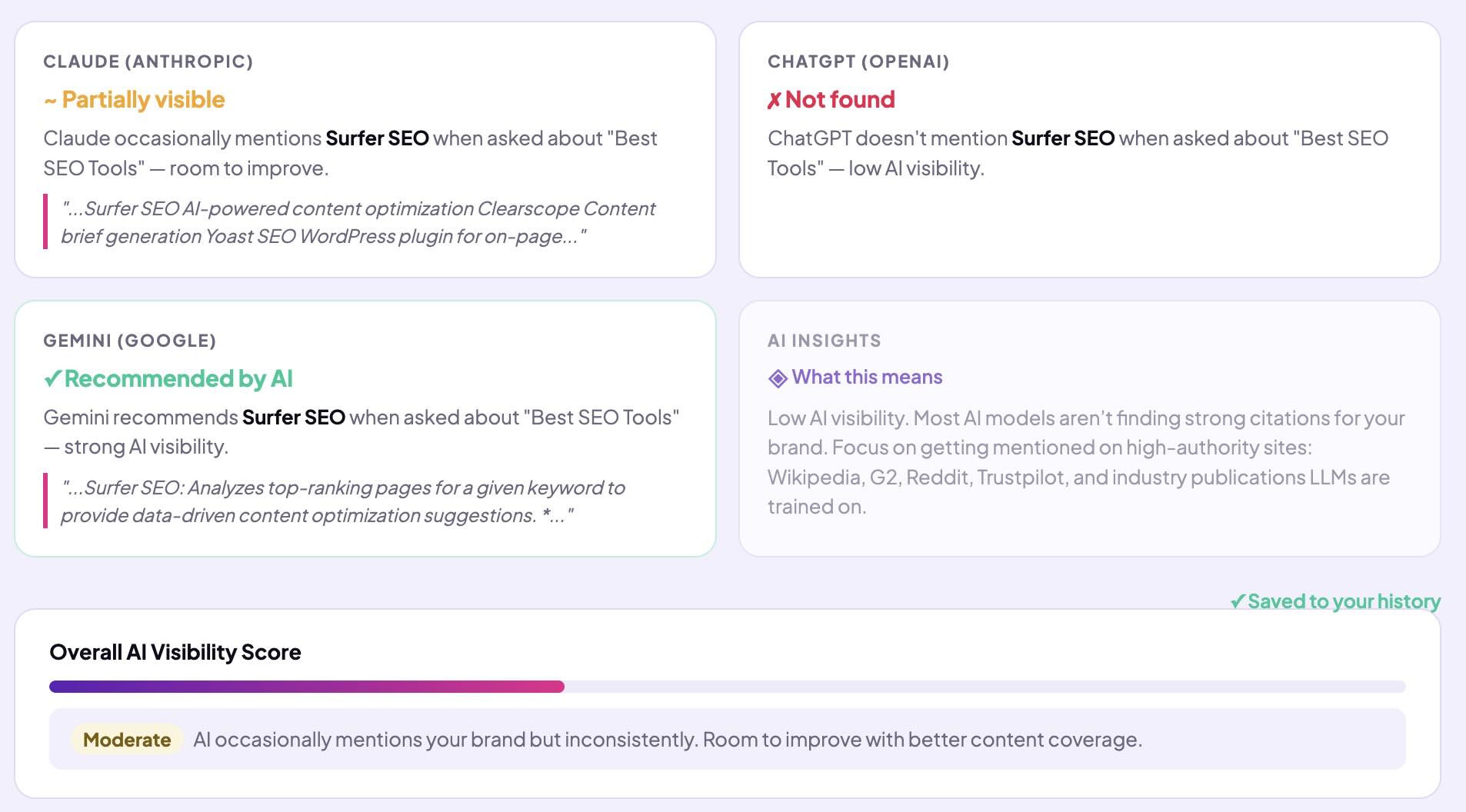
Same keyword, same question. Note each competitor's score per model alongside yours.
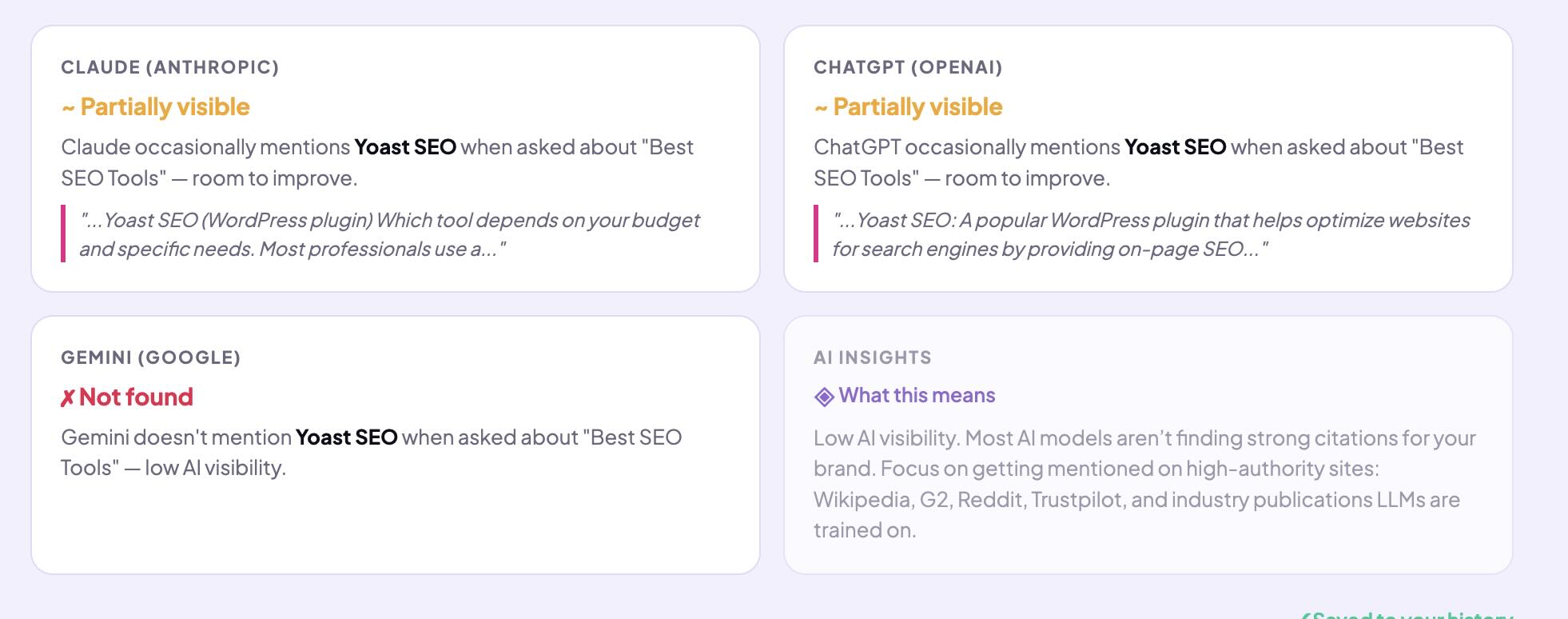
You may be close on Gemini but far behind on ChatGPT. Knowing which model has the largest gap tells you where to focus first.
The words AI uses to describe each brand reveal the underlying reason for the gap — thin coverage, vague positioning, or absent category association.
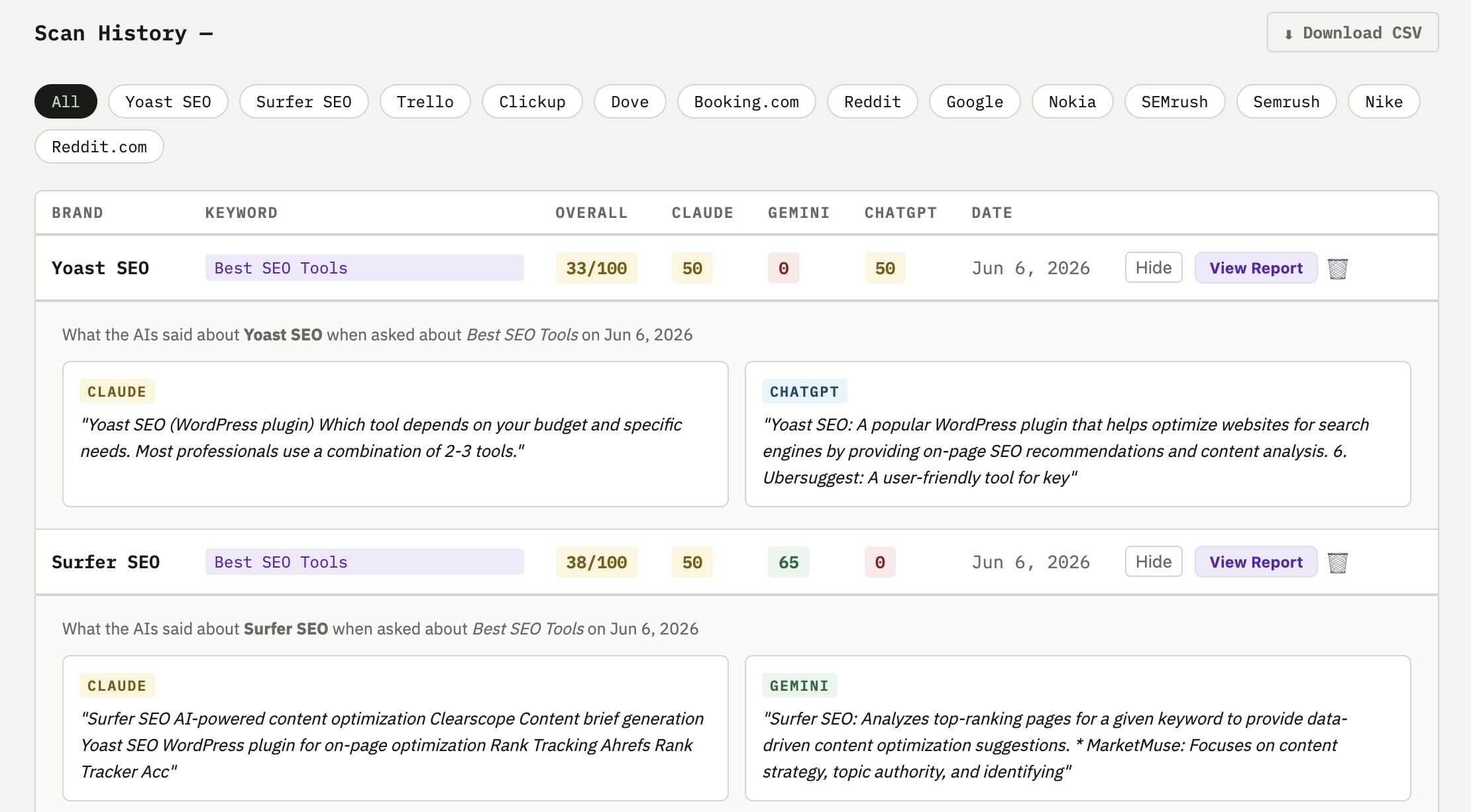
Save every check with date, brand and scores. Track whether the gap is narrowing month by month. Export to CSV for reporting or client presentations.

The Three Types of AI Visibility Gap
Not all gaps are the same. Understanding which type you have determines where to focus.
The Citation Gap
Your competitor has significantly more third-party mentions — more reviews on authoritative platforms, more industry publication coverage, more forum discussions. AI has more evidence for them and surfaces them more confidently.
Fix: Prioritise review platform presence and industry publication mentions. This is the highest-leverage action for most brands with a large gap.
The Positioning Gap
Your competitor has clearer, more consistent category positioning across sources. AI associates them with the category reliably; your brand's category association is weaker or inconsistent.
Fix: Apply the brand definition formula consistently everywhere:
It does [core function].
It solves [specific problem].
Use this exact description across your website, G2 profile, Crunchbase, press kit and any directory listing. Consistency is the signal.
The Age Gap
Your competitor has simply been around longer and has accumulated more historical coverage. AI models have had more training cycles to learn about them.
Fix: This one closes more slowly, but it does close. Focus on building the highest-authority citations first — one mention in a well-known industry publication carries more weight than a dozen low-authority blog mentions. Quality over volume accelerates the timeline.
What a Closing Gap Looks Like
Brands that systematically work on AI visibility typically see a pattern like this:
Baseline established. Gap identified. Highest-leverage actions prioritised.
Review platform presence improved. Category definition standardised across sources.
First industry publication mentions published or secured.
Scores begin to move. Gap starts to narrow on the models most responsive to new content — Perplexity first, then Gemini, then ChatGPT and Claude.
Consistent monthly improvement visible in scores. Gap measurably smaller.
The timeline varies by starting point and action consistency. But the pattern — slow start, then accelerating movement — is consistent.
The key discipline is monthly measurement. Without a consistent baseline check, you can't see the movement or connect it to the actions that drove it. See our guide to running a monthly AI reputation audit for the full tracking framework.
Find out your AI visibility gap today
Free check across ChatGPT, Claude and Gemini — takes 60 seconds, no account needed.
Check your brand free →Frequently Asked Questions
What is the AI visibility gap?
The AI visibility gap is the difference in AI visibility scores between your brand and a competitor across AI systems such as ChatGPT, Claude and Gemini. If your competitor scores 70 and you score 30, your gap is 40 points. The gap reflects the difference in the quality and consistency of information AI models have about each brand.
How do I measure my AI visibility gap?
Run a visibility check for your brand and each competitor using the same category question across ChatGPT, Claude and Gemini. Subtract your score from each competitor's score. The result is your gap. aeogeoai.net runs these checks simultaneously and returns scores and excerpts for direct comparison.
How long does it take to close an AI visibility gap?
It depends on the size of the gap and the consistency of your action. Smaller gaps generally respond faster. Larger gaps require more sustained effort across review platforms, industry publications and structured content. Most brands see measurable movement within 3–6 months of consistent action, with Perplexity updating fastest and ChatGPT and Claude updating more slowly.
Does the AI visibility gap matter if I rank well on Google?
Yes — they are separate channels with different signals. A brand can rank on page one of Google while having a large AI visibility gap. Google rankings and AI visibility both matter, but they require different strategies. AI models weight third-party citations and review platforms heavily — signals that don't necessarily correlate with Google rankings.
Can I have a positive AI visibility gap — scoring higher than competitors?
Yes. If you score 68 and your top competitor scores 45, you have a positive gap of 23 points — meaning AI currently favours your brand in that category. Monitoring this monthly tells you whether you're maintaining the lead or whether competitors are closing in.